Wednesday, January 25, 2012

Daddy Saves the Day

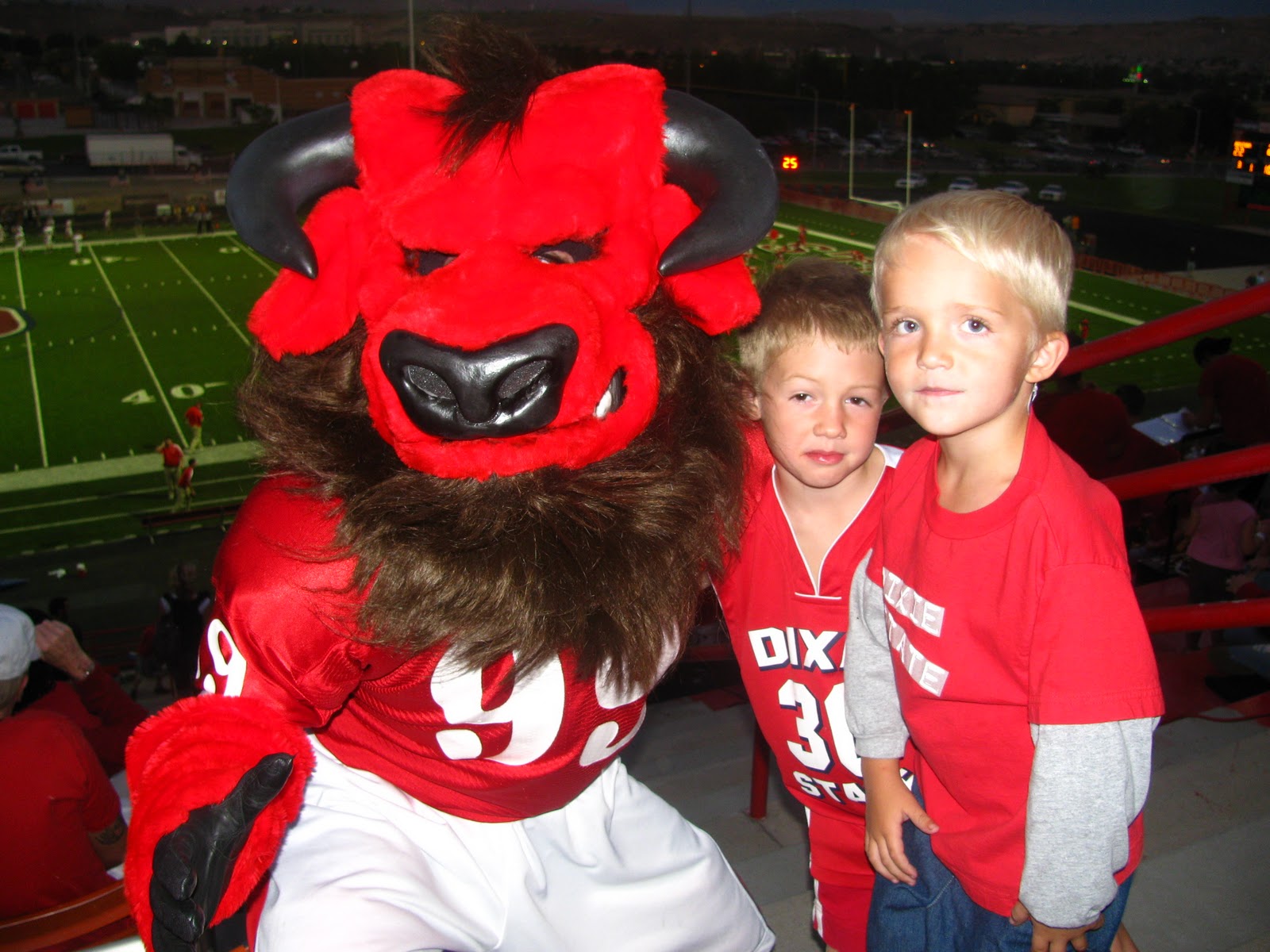
See this creature?


His name is Big D.  He's the mascot for Dixie State College.

Little Guy LOVES Big D.

Last week, my husband invited Little Guy to attend a DSC basketball game with him so they could have some bonding time.  Basketball games are full of sensory issues (noise, crowd, etc.) so Daddy planned in advance by bringing along Little Guy's Superman hat (see post here) and arriving at halftime for a shorter stay.

However, Dad forgot one thing:  Big D.

Or rather, I should say Little Guy's obsession with Big D.

As soon as they walked in the arena, Little Guy's mission became to catch the mascot's attention.  Every time Big D would face their way, our son would excitedly wave his arms - only to be seemingly "snubbed" by his idol.  My husband sent Little Guy a few rows down where Big D was talking to a group of kids; but by the time he got there, Big D had turned his back and was walking away. 

Little Guy became increasingly upset and frustrated as the game wore on.  As an adult, one can understand that Big D's job is to work the crowd and get them cheering for the team.  He has a lot to do, and the mascot head is large and makes it difficult for him to see everything - making it easy to overlook a small child.  However, Little Guy didn't understand these details; he could only see that Big D wasn't paying attention to him.  He was trying hard not to "lose it" but was becoming dangerously close to having a big meltdown.

This is where my husband intervened.  After watching Little Guy's thwarted efforts and sensing our son's growing anxiety, he decided to take matters into his own hands.  Although it was a close game, Dad decided it was more important to help Little Guy track Big D down and get the "high five" he was so desperately wanting.  So up and down the aisles they went in an effort to catch the mascot; apparently at one point, they were even running down one of the empty rows, hopping over the chairs in order to reach him.

Finally...they had success!  Daddy said they'd had many strange looks during their "chase", but that it was all worth it to see the big smile on Little Guy's face when he shook Big D's hand and received the long-awaited high five.  Little Guy came home ecstatic; Daddy came home exhausted :)

Thanks to my hubby who was so understanding of Little Guy's needs and was able to turn a potentially disastrous situation into a positive one.  I am so glad he stepped in to save the day!

Wednesday, January 18, 2012

The Right Direction

Last week, Little Guy had his initial assessment with a new therapist.  During the session, we discussed many issues, especially my main concern that Little Guy seems to be quite disregulated lately.  The therapist asked if we'd recently had any major changes within the family;  as I thought about it, I realized there have been many disruptions in our household the past several weeks:

We celebrated three major holidays.

Big Guy and Sis both moved back home.

My husband has been out of town more than usual.

We just welcomed a foreign exchange student from Japan who will be staying with us for two months.

Yes, I guess one could argue we've experienced some major changes lately, which might help explain some of Little Guy's increased anxiety levels.  Individuals on the spectrum do NOT take to change very easily - as any of you who live or work with these children know :)  However, I feel this doesn't completely explain Little Guy's behavior, as it began regressing about 3 or 4 months ago. 

Perhaps it's the stress of attending a  more "normal" school? 

Whatever the reason, tomorrow we begin weekly therapy sessions to address Little Guy's anxiety issues.  Our first goal is to help Little Guy begin to recognize when his anxiety levels are escalating.  Once he realizes he's in danger of feeling overwhelmed, his next step would be to let us know so we can help him calm down.  Our ultimate goal is for Little Guy to eventually learn his own ways to regain control over his emotions and behavior when he is feeling anxious. 

I know I can't expect change to happen overnight;  in fact, this could be a long, arduous process.  However, I feel we're taking a step in the right direction!

Saturday, January 7, 2012

Back to the Drawing Board

I apologize for the gap between posts - we had a crazy holiday break, and it's taken me some time to get back into the swing of things.

December was NOT a good month for Little Guy.  For a few months now, we've felt he's regressed in several areas of his behavior; last month, our suspicions proved correct.  Little Guy has been having a much harder time staying regulated at home and school, which is translating to more frequent and more intensive meltdowns.  

We are doing all we can at home to help manage these outbursts, but unfortunately, it just isn't enough.  Little Guy struggles with a great deal of anxiety, which we've been unable to help him cope with.  This, in turn, triggers feelings of frustration and anger when he's dealing with certain situations.  This cycle is affecting his ability to maintain relationships, perform at school, and is creating a lot of stress in our home. 

In other words, it's time for a change.

We've gone back to the drawing board for ideas on where to turn next, and have decided to pursue a few different routes.  First, we are having him evaluated by Intermountain Southwest Behavioral Health.  They have a couple of therapists who work exclusively with children and are  experienced in dealing with autism disorders.  We are also working to get him seen again by Dr. Roth, a psychologist from Primary Children's who gave Little Guy his initial diagnosis of Asperger's Syndrome a couple of years ago.  If these measures don't work, we've recently learned of a new program in the area that appears to take a comprehensive, aggressive approach to treating autism.

As Little Guy will be entering public school in the fall, I feel it's extremely important we address these behaviors as soon as possible.  If Little Guy was expected to go to kindergarten now, I honestly don't think he'd be able to handle it :( 

Luckily, we were able to get our little one in for his initial therapist evaluation this coming Monday.  I'm interested to get feedback from a professional standpoint and hope this is the beginning of a positive era in our family's battle with autism.

Saturday, December 24, 2011

Superman to the Rescue

One of Little Guy's sensory issues deals with sound.

Loud noises, especially when unexpected, can be very problematic.  He gets agitated and upset, and this behavior sometimes escalates into a full-blown meltdown.  Circle time at preschool has been especially tricky, trying to balance his needs and the other children's eagerness to participate  - sometimes, quite loudly.  I've talked to the class, explaining that inside voices are appropriate for the classroom.  I've also shared that Little Guy has "super ears", making sounds seem louder than they really are.  These measures have helped, but there are still times when the entire class is reciting the pledge of allegiance or singing together that it is just too much for him.

So, I came up with a solution:

A Superman hat to cover Little Guy's "super ears".

All during the month this hat has accompanied us to swim meets, ball games, and the preschool program.  While it doesn't block every sound, it muffles and filters many noises at loud events, allowing Little Guy's anxiety levels to be much lower.

And the results?

I'd say they've been..."super" :)

Friday, December 16, 2011

Music to My Ears

Little Guy had his five year check up with his pediatritian last week.  Everything looked great - Little Guy is growing beautifully and all of his body systems look healthy.  At the end of the appointment, the doctor and I spent a few minutes discussing Little Guy's Asperger diagnosis.  The physician seemed pleased with the progress my son has made over the year in regards to increased eye contact and a greater desire for interaction with others.

I attributed these positive changes to an early diagnosis.  The doctor whole-heartedly agreed with me, then went on to share some wonderful information.  He told me that health care professionals are starting to screen toddlers for signs of austism as early as 18 months, then again at two years.

This was music to my ears.

Early diagnosis = early intervention.

Earlier intervention = a chance to change and/or minimize behaviors while the brain is young and pliable.

I feel this could have made a world of difference for Big Guy.  He was misdiagnosed with ADD in second grade and given medication he really didn't need.  After years of worry and frustration, he finally received an Asperger diagnosis at age 16.  At that point many of his behaviors were already ingrained, and we had missed the opportunitiy to intervene at critical points in his development.  Although we did many things instinctively right at as his parents, there are certain situations we look back on and wish we could change.  We wish we would have been armed with the knowledge we now have.

That's why, when Little Guy showed many of the early characteristics Big Guy had as a baby, I pushed to have him evaluated.  Against the recommendation of close family members who were worried about "labeling" him.  I felt that if Little Guy was on the spectrum, it would be beneficial for him to receive help as early as possible.

Has it made a difference?  I believe so.  Although we struggle with spectrum issues daily, Little Guy is high functioning.  And while he still experiences meltdowns, they are generally becoming less intense and shorter in duration.  However, the most important development I've seen is a desire to be social.  This is HUGE.  Little Guy doesn't always understand what's appropriate and becomes overwhelmed in group settings, but he is doing fairly well when interacting with one or two of his peers.  Since the desire is there, I hope we can use it to improve and expand his social skills. 

Big Guy has never had this desire.  Would this be different had we known earlier what he was facing and how to help him?  We'll probably never know for sure, but my hunch is that it definitely could have helped.

When parents bring up concerns about their child's behavior and ask my advice, my response is always the same.  IF YOU HAVE QUESTIONS ABOUT YOUR CHILD'S DEVELOPMENT, HAVE THEM TESTED.  In many cases, the testing is free.  And if others think you are being overprotective or paranoid - do it anyway.  After all, you know your child better than anyone :)  If nothing is wrong, you can experience peace of mind knowing everything is developing "normally".  If a diagnosis is made, you will be given the knowledge and help to begin making positive changes in your child's life.  Either way, I see it as a win-win situation!

Monday, December 5, 2011

A Piece of Paper


I've been wondering lately why I feel so upset and unsettled about Little Guy and his struggles with Asperger's Syndrome.  After all, there are children going through much worse things like cancer, organ transplants, and degenerative diseases.  Illnesses that are life and death situations.  Luckily, Little Guy is healthy, and although on the autism spectrum, he is fairly high functioning.

So why do I feel on edge all of the time?

I've decided it's the unpredictability of our situation which makes it feel so difficult.  Not knowing when and how Little Guy is going to handle situations.  Not knowing what might set him off.  Realizing that even with careful planning, something unexpected can undo all of my preparations.

Something as simple as a piece of paper.

Last week in preschool, we were singing a counting song involving pieces of paper.  During the course of the song, the teacher selects a few students at a time to pick a piece of paper.  This continues until ten are picked in all.  In order to make the song more inviting, we use scrapbook paper for the kids to choose from.  Little Guy really wanted to be chosen to participate in the song; but in order to make it not seem like I was favoring my son, I decided to choose him on the last turn.

Huge mistake.

Little did I know he'd already decided on the piece of paper he'd wanted - and it was gone when his turn came.  One thing about kids on the spectrum is that once they have something fixed in their mind, it is extremely difficult for them to switch gears.  If something happens contrary to their expectations, it can be very upsetting.  Some autistic children may shut down, others may act out.

Little Guy is the second category.  Within seconds, we had a full-blown meltdown on our hands. 

The other kids were staring as Little Guy starting yelling, crying, and flailing.  They were puzzled why he would fall apart over a piece of paper.  I tried to continue the lesson while the other teacher took Little Guy over to table and attempted to calm him down.  It was a good 10-15 minutes before he stopped crying, and another 45 minutes before he stopped talking about it.

I'm grateful that Little Guy was able to regulate himself fairly quickly - sometimes, episodes like this can affect our entire day.  However, it was frustrating to realize that when trying to minimize potential triggers in Little Guy's world, something might escape my notice.  Something that might negatively impact the rest of our day.

Something like...a piece of paper.

Monday, November 28, 2011

Absolutely Astounding

A few weeks ago, I bumped into a former classmate of mine.   We happened to arrive around the same time at an indoor trampoline arena; I had Little Guy with me, and she was with her children - a little boy and girl.

I've only seen her a handful of times since graduation, mostly at holiday celebrations in our hometown.  She didn't recognize me right away, but I decided to approach her.  I introduced myself and we chatted for a moment.  A short time later we found ourselves together in the same area of the lobby, filling out permission forms for our kids.  As I was busy writing down information, she leaned over to me and said, "You know, I just came across your blog."  She proceeded to tell me that her seven-year-old son was struggling with many issues similar to Little Guy and that they were in the process of having him tested for Asperger's Syndrome.

I was astounded.  You see, she was the sixth person to approach me in the last month.  These have been friends, neighbors, and acquaintances who, upon reading this blog, have shared their own struggles raising a child with sensory, anxiety, and/or autistic issues.  In most of these cases, I had no idea these individuals were going through the same journey as I.  While this revelation helped reaffirm my efforts in spreading awareness and information to others, it also proved what an epidemic autism and its related disorders are becoming.

When our oldest had his diagnosis given four and a half years ago, I spent many hours of research on the internet.  At that time, it was estimated that 1 in 166 children would be diagnosed with some form of autism.  Recent research now suggests that number is closer to 1 in 100 children. 

What's happened?  Why are the numbers increasing?

Part of it is due to greater awareness and better diagnostic procedures.  However, I find it hard to believe these factors have solely been responsible for this dramatic increase.  There are many theories out there which include diet, in-utero stress, exposure to a virus during a critical time of fetal development, immunizations, genetics - the list goes on and on.  I'm a numbers type of person; to convince me of a statement's validity, it needs to be backed up by reliable data.  And the frustrating fact is, none of these factors have been proven to cause autism.  Studies do show that once a couple has one child diagnosed with an autistic spectrum disorder, their chances of having a second child with a similar condition jump to 1 in 7.  This suggests a hereditary predisposition linked to autism - but the problem is, if there is a gene responsible for causing autism, it has yet to be discovered. 

In the meantime, those of us who care for an autistic child will continue to do what we can to minimize disruptive behaviors while helping them make sense of an often confusing world.  And while we cope with autism's effects, we look forward to the day when the cause - and cure - of this condition will be found.